About this essay
I’ve written about this question three times: an Arkwright essay, a researched rewrite in 2020, and my EPQ in 2021. There’s a lot of overlap between them, so this page merges the three into one argument. The short version: consciousness grows out of instinct, instinct is irrational, and computers are built to be perfectly rational.
The problem
The simplest way of describing consciousness is our sentience: our awareness of internal and external existence. It’s what many people believe gives us our emotions, our feelings and our ability to think outside ourselves. We all know what consciousness is, because we feel conscious, but trying to pin it down is virtually impossible.
That’s what makes it so interesting to me. Consciousness is integral to every little thing we do, yet it’s taken for granted, when in reality we have hardly any idea what it is or where it comes from. Whether it can be recreated on a computer isn’t just a technical question. The answer changes what we think we are.
If nothing else, we know our own consciousness exists. Everything else could be an illusion or a dream, but as Descartes put it, “I think, therefore I am.” Yet even that can’t be proven to anyone else. If you stepped into a cloning machine, your clone would report feeling exactly as conscious as you. You’d have no way of knowing whether they were telling the truth or just saying what you would say.
Two kinds of consciousness
Ned Block distinguishes access consciousness, the rational part that handles things like arithmetic, from phenomenal consciousness: what it feels like to be you. Phenomenal consciousness is what people usually mean by consciousness or sentience, and it’s often called the hard problem.
Block isn’t the first to split the mind like this. Aristotle divided the soul into a rational part (analytical) and a non-rational part (desire and emotion). The fact that the ancient Greeks drew nearly the same line shows how little progress we’ve made on the question.
Michael Gazzaniga, who works on split-brain research, defines consciousness as “the subjective feeling of several instincts and/or memories playing out in time in an organism.” Hold on to the word instincts.
Where consciousness came from
The most basic consciousness probably appeared in the first animals that needed to search for food they couldn’t see. This is object permanence: knowing something exists even when you can’t sense it. Jean Piaget pioneered testing it in babies and found it doesn’t develop until around 8 months old. Bacteria don’t need it, because they can wander haphazardly until they bump into food.
The mirror test, developed by Gordon Gallup Jr in 1970, measures self-awareness. Humans usually fail it until about 18 months, and only some mammals and birds ever pass. Your dog is far less intelligent than you but seems just as capable of feeling. That suggests intelligence isn’t the same thing as consciousness; a little intelligence might help you use consciousness, but it isn’t the source. Consciousness is likely a spectrum rather than an on/off switch.
As for where in the brain it lives, many neuroscientists expect it co-evolved with the cerebral cortex, where language and reasoning happen. But Gazzaniga points out that children born with hydranencephaly, whose damaged forebrain tissue is replaced by fluid, grow up without language yet still express feelings and have subjective experiences. He suggests consciousness might start in the evolutionarily older midbrain, with the cortex adding “a collection of extensions to enhance conscious experiences”. The oldest, most instinctive parts of the brain are exactly where I’d expect to find it.
My argument: consciousness is irrational
In Thinking, Fast and Slow, Daniel Kahneman describes two modes of thought. Fast thinking is instinctive, emotional and quick to cut corners. Slow thinking is deliberate and logical. Fast thinking is believed to be an evolutionary trait that let our ancestors make life-saving decisions in harsh environments without stopping to reason.
Fast thinking is also where irrationality comes from. Take loss aversion: most people would rather not lose £5 than find £5, even though the outcome is the same. As Kahneman puts it, “losses loom larger than gains.” A computer weighing the same choice sees two equal outcomes.
Most people assume our instincts come from our consciousness. I think it’s the other way round: we’re conscious because of our instincts. Our complex consciousness came from our unconscious, irrational behaviour, and despite those irrational tendencies (or because of them) we’re the smartest species we know. Nietzsche and Bergson also put instinctive drives at the heart of existence, and Schelling argued that the “dark ground” of existence is irrational and can only be described apophatically: by what it isn’t. That’s exactly how we’re forced to talk about consciousness.
Why computers can’t (yet)
Computers are masters of rationality. They predict stocks and measure the distance to stars. They never cut corners on purpose; when they do, it’s a bug or an instruction, not a thought. Even “random” number generators aren’t random: they either sample outside noise (entropy) or fake it with a pseudorandom algorithm.
Irrational numbers show the gap nicely. A computer stores pi as a handful of digits, or as a symbol it doesn’t understand. We understand what pi is, infinite digits and all. Computers only know as much as they’re given.
Computers are deterministic, and programming languages are bound by that. So the phrase “artificial intelligence” contains a contradiction: programming means telling a computer exactly how to solve a problem, while intelligence means autonomous thought.
This means you could build an AI that acts exactly like a person and still not be conscious. Philosophers call that a philosophical zombie: physically and behaviourally identical to a person, with no experience inside. John Searle’s Chinese Room makes the same point. A man who speaks no Chinese sits in a room with a rulebook. Chinese messages come in, he follows the rules, and perfect Chinese replies go out. To the outside world he understands Chinese. He doesn’t understand a word. Searle says that’s all a computer is.
Could we build one anyway?
My first idea, from the original essay, was to change the hardware. A computer without an arithmetic unit would be terrible; adding one unlocks huge new capabilities. So what if we added a unit that handles irrationality: something that can hold a paradox like “today is opposite day” without breaking, and think fast rather than exactly?
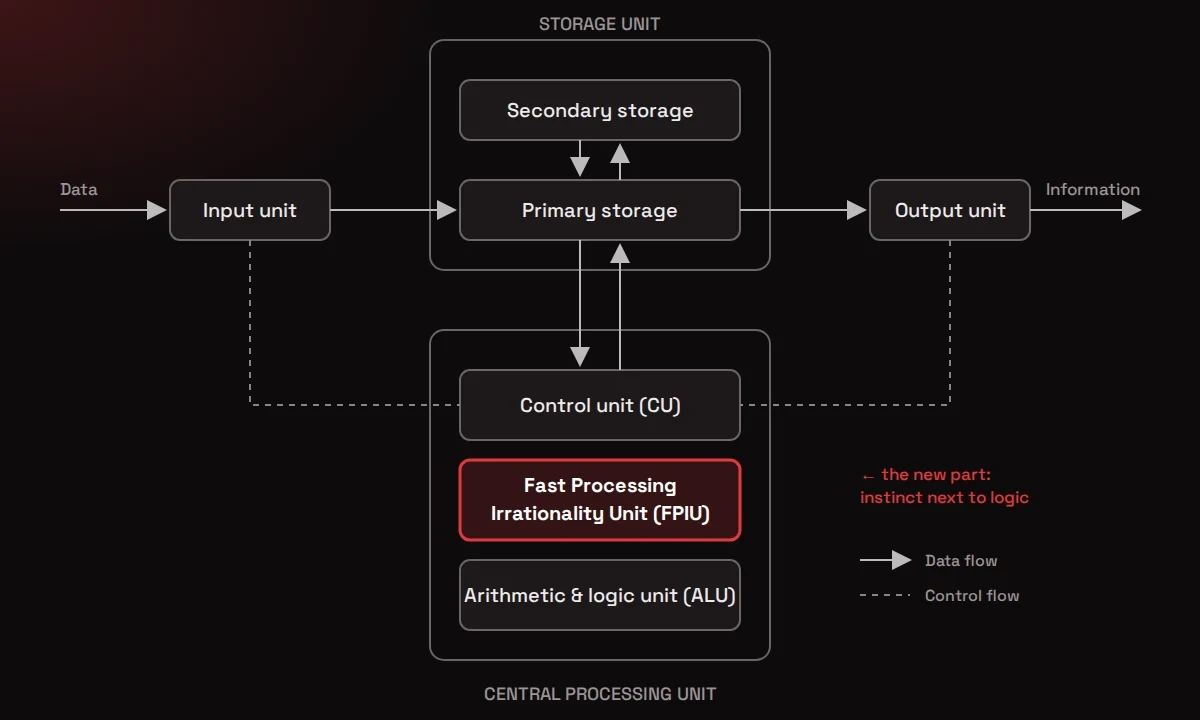
My “Fast Processing Irrationality Unit”: a standard CPU with an instinct unit alongside the control unit and ALU.
The second route is physics. Roger Penrose argued in The Emperor’s New Mind that consciousness isn’t computational at all: “We need a major revolution in our understanding of the physical world to accommodate consciousness.” With the anaesthesiologist Stuart Hameroff he proposed that microtubules inside neurons could be quantum devices (a theory called Orchestrated Objective Reduction). If true, a classical computer could never be conscious, but a quantum computer, whose qubits can be in a superposition of on and off, might be. They’re huge, need cooling to a fraction of a degree above absolute zero, and are hard to maintain, which might be a blessing: nobody’s building a sentient AI in their back garden.
The third route is biology. We’ve cloned mammals since Dolly the sheep in 1996, and a clone grown like any other animal is presumably conscious. Recreating consciousness biologically seems far more likely than recreating it digitally.
What if we did?
Free will. If an electronic signal could do what our minds do, we might be nothing more than products of our environment, our fate set since the Big Bang. Then should anyone be held responsible for their actions? If consciousness needs quantum effects (or a soul), unpredictability survives, and so might free will.
Rights. If we ever built a test that proved an AI wasn’t just faking it, we’d have to treat it as an equal being.
Identity. Uploading a mind runs into the teletransportation paradox: if you’re scanned, rebuilt somewhere else and the original destroyed, is the copy you, or a clone who thinks he’s the original? Ray Kurzweil’s thought experiments ask the same question.
Work. Computers already replace jobs, like Amazon’s checkout-free store in 2018. Conscious AI could take the creative, out-of-the-box work too. Elon Musk and Andrew Yang have both argued that universal basic income will stop being a choice. Stephen Hawking warned that machine-produced wealth could give everyone a life of leisure, or leave most people miserably poor if it isn’t shared.
War. An AI that adapts like a human with superhuman intelligence would be the next arms race. Hawking feared AI could become “a new form of life that will outperform humans”. Musk’s answer is to join it: Neuralink has already shown a macaque playing Pong with its mind.
Where I landed
Computers are too rational to think outside themselves. They can’t ponder the meaning of life unless they’re given enough information, and they can’t have blind faith unless they’re told to. You can’t make one truly irrational without quantum states or something like them. If a computer ever became irrational like that while keeping complex intelligence, I’d consider it conscious, and it should get the same rights as a human.
I think biological replication will come first. Conscious AI would be a real threat, but there’s little reason to build it when ordinary AI does the job with far less processing, so those concerns are for the distant future.
Looking back
Since writing this, large language models have arrived. They’re statistical rather than classically rational, so they sort of emulate fast thinking, but they’re still not at the level of human instinct. That makes today’s LLMs pretty much philosophical zombies: they can say everything a conscious mind would say. The same idea about instinct now sits at the centre of how I think about flow: see The Art of Flow.
Sources: Kahneman, Thinking, Fast and Slow (2011) · Penrose, The Emperor’s New Mind (1989) · Gazzaniga, The Consciousness Instinct (2018) · Block, The Nature of Consciousness (1997) · Searle’s Chinese Room (Stanford Encyclopedia of Philosophy) · Gallup, “Chimpanzees: Self Recognition”, Science (1970) · Piaget, Psychology of Intelligence · McGrath, The Dark Ground of Spirit: Schelling and the Unconscious (2011) · Schopenhauer, Essays and Aphorisms · Hameroff, Ultimate Computing (1987)